________________________________________
The Godet Afrikan Burial Ground
Honoring the Afrikan Ancestors of St. Eustatius
________________________________________
A Place of Memory and Connection

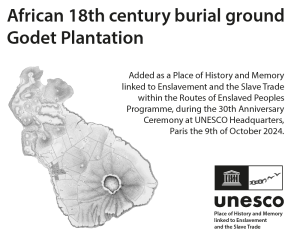
Perched on a sea-cliff on the island of St. Eustatius lies the Godet Afrikan Burial Ground — the first large Afrikan burial site discovered on the island.
It is a resting place for enslaved Afrikans who lived and worked on St. Eustatius, and for others who died during their forced transit through the island.
The careful placement of the graves shows that they were not buried at random — even in bondage, the dead were treated with dignity and care.
This site tells a story of humanity, resilience, and community bonds formed under the trauma of slavery.
Each grave stands as a quiet testament to lives lived in struggle and solidarity — lives that helped shape the identity of St. Eustatius and its people.
________________________________________
Remembering Through Community
For the people of St. Eustatius, the Godet site is more than an archaeological discovery — it is a living connection to their ancestors.
Through these acts of remembrance, new generations continue to reclaim a history that was long overlooked and to celebrate the endurance of their heritage.
________________________________________
St. Eustatius: The Golden Rock
In the seventeenth and eighteenth centuries, St. Eustatius — a small Dutch Caribbean island near St. Maarten and St. Kitts — became known as the “Golden Rock.”
Its harbor was one of the busiest in the Caribbean, serving as a free port where goods and people were traded without taxes or duties.
Among those “goods” were captured Africans, brought to the island to meet the growing demand for enslaved labor on plantations across the region.
Many were temporarily confined at Fort Amsterdam (the Waterfort) before being sold locally or shipped to neighboring islands.
The Godet Burial Ground, located near this fort, directly connects St. Eustatius to the vast and painful network of the trans-Atlantic and inter-island slave trades.
________________________________________
The Site Today
The burial ground lies on a sloping cliff overlooking the sea. Time, wind, and water have eroded the soil, gradually revealing graves that had lain hidden for centuries.
Initial excavations were carried out by the St. Eustatius Center for Archaeological Research (SECAR) in 2012, followed by additional work by Texas State University in 2018 after hurricanes Irma and Maria.
Sadly, the ancestral remains that were uncovered were taken off the island without consultation with descendant communities, and their current location is unknown.
Today, the site remains vulnerable to coastal erosion. In 2022, boulders were placed to slow further loss of land, but little has been done to secure or properly conserve the burial ground.
The graves now lie exposed, covered by torn tarps and rough stones — a stark reminder of the need for respect, protection, and care.
________________________________________
Why UNESCO Recognition Matters
Granting the Godet Afrikan Burial Ground UNESCO “Site of Memory” status is a powerful act of recognition and justice.
It can contribute to :
- Protecting the site from further disturbance.
- Encourage the return of ancestral remains to their rightful resting place.
- Acknowledge Afrikan burial grounds as sacred heritage sites deserving of equal respect as other cemeteries.
- Empower local communities to lead remembrance and educational efforts.
UNESCO recognition also can raise international awareness, and foster diaspora connections, ensuring the story of the Godet Ancestors is never forgotten.
________________________________________
Preservation Challenges
At present, the burial ground has no legal protection and is not listed as a monument.
Its exposed cliffside location puts it at constant risk of destruction from erosion.
While the island falls under the Monuments and Historic Buildings (BES Islands) Act, enforcement and heritage supervision are limited compared to the European Netherlands.
This leaves sites like Godet especially vulnerable.
To honor the ancestors, the burial ground must be properly documented, stabilized, and transformed into a respectful space of reflection and education — not left to the sea.
________________________________________
Recognition, Justice, and Development
The story of the Godet Afrikan Burial Ground aligns with the three pillars of the UN International Decade for People of African Descent: Recognition, Justice, and Development.
These ancestors last resting places — unseen, unmarked, and often unnamed — represent the countless lives that formed the foundation of the Caribbean.
Honoring them is an act of cultural justice and historical truth.
By preserving this sacred ground, St. Eustatius contributes to a global movement acknowledging the humanity, resilience, and legacy of the enslaved — and to a shared future built on remembrance, respect, and restoration.
—
See also our blogpost How Not To Do Archaeological Research: the Case of the Godet African Burial Ground (August 2021)